
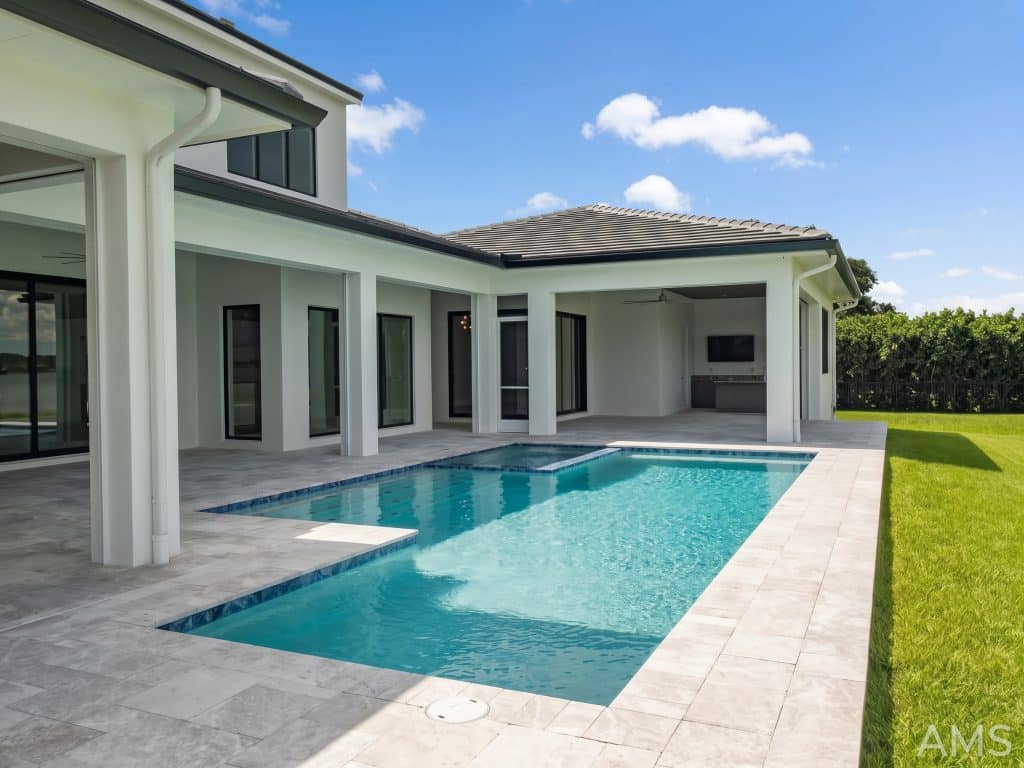
Every Florida contractor has had this conversation with a client: “Why should I pay for travertine when concrete pavers cost less?” It is a fair question — and the honest answer is that at true wholesale pricing, natural stone often costs the same or less than premium concrete, while outperforming it in almost every category that matters in our climate. Here is the comparison we walk through with builders and homeowners at our Orlando warehouse.
Heat: The Barefoot Test
This is where the conversation usually ends for pool decks. Concrete pavers absorb and hold heat; on a summer afternoon they become genuinely painful to walk on. Travertineu2019s porous structure and light color keep it dramatically cooler — cool enough that kids can run across it at 2 PM in August. For lanais, patios, and anywhere bare feet land, travertine wins without argument.
Lifespan: 10 Years vs Generations
Concrete pavers are a manufactured product with a wear layer. In Florida sun, the color fades within 5–8 years, the surface begins to pit and expose aggregate, and salt-chlorine splash accelerates all of it. Travertine is solid stone — the same material the Romans used for the Colosseum. It does not fade because the color goes all the way through. A travertine deck installed today will outlast the mortgage.
Repairs: Invisible vs Obvious
Crack a concrete paver in year four and the replacement will never match — the surrounding pavers have faded, the new one has not. Crack a travertine paver and the repair disappears, because natural stone weathers uniformly. Contractors who maintain properties long-term tell us this alone sells clients on stone.
Slip Resistance
Tumbled and leathered travertine finishes provide reliable grip when wet — the texture is part of the stone, not an applied coating. Concrete pavers rely on their mold texture, which wears smooth over time, especially in high-traffic paths from the pool to the door.
Home Value and Appraisals
Real estate agents in Central Florida consistently flag natural stone hardscaping as a value feature in listings. “Travertine pool deck” reads as an upgrade; “concrete pavers” reads as standard. For homeowners thinking about resale, stone is one of the few outdoor improvements that shows up in buyer perception and appraisal notes.
Cost: The Part Everyone Gets Wrong
Retail travertine at a big-box store is expensive — that part is true. But contractors buying from a direct importer pay container-direct wholesale prices. On recent jobs, our travertine paver collections have quoted within a few percent of premium concrete paver lines — and below them on larger volumes. When the material costs are nearly equal, the lifetime math is not close.
- Concrete pavers: lower upfront cost, 8–12 year cosmetic lifespan, fading, patching repairs
- Travertine pavers: similar wholesale cost, generational lifespan, no fading, invisible repairs, higher home value
Where Concrete Still Makes Sense
To be fair: for temporary surfaces, tight-budget rental properties, or areas that will be rebuilt soon anyway, concrete pavers do the job. And for very heavy vehicular applications, thick concrete units rated for the load can be the practical choice. We tell contractors the truth even when it does not favor us — it is why they keep buying from us.
See and Feel the Difference
The fastest way to settle this with a client is to put both materials in their hands. Bring them by our Orlando warehouse — we will pull Ivory, Silver, and Autumn Blend travertine off the pallet and let them compare against any concrete sample they bring. The stone sells itself.
Contractors: request a wholesale quote or call +1 (689) 316-9090 for current pallet and container pricing. Pickup at 6343 All American Blvd, Orlando, or delivery across Central Florida.